

Henna Hair Dye FAQs
Henna’s not just the hippy color your parents experimented with in the ‘70s, it’s the choice of natural hair dye for anyone who wants color, gloss and vibrance without damaging their hair.
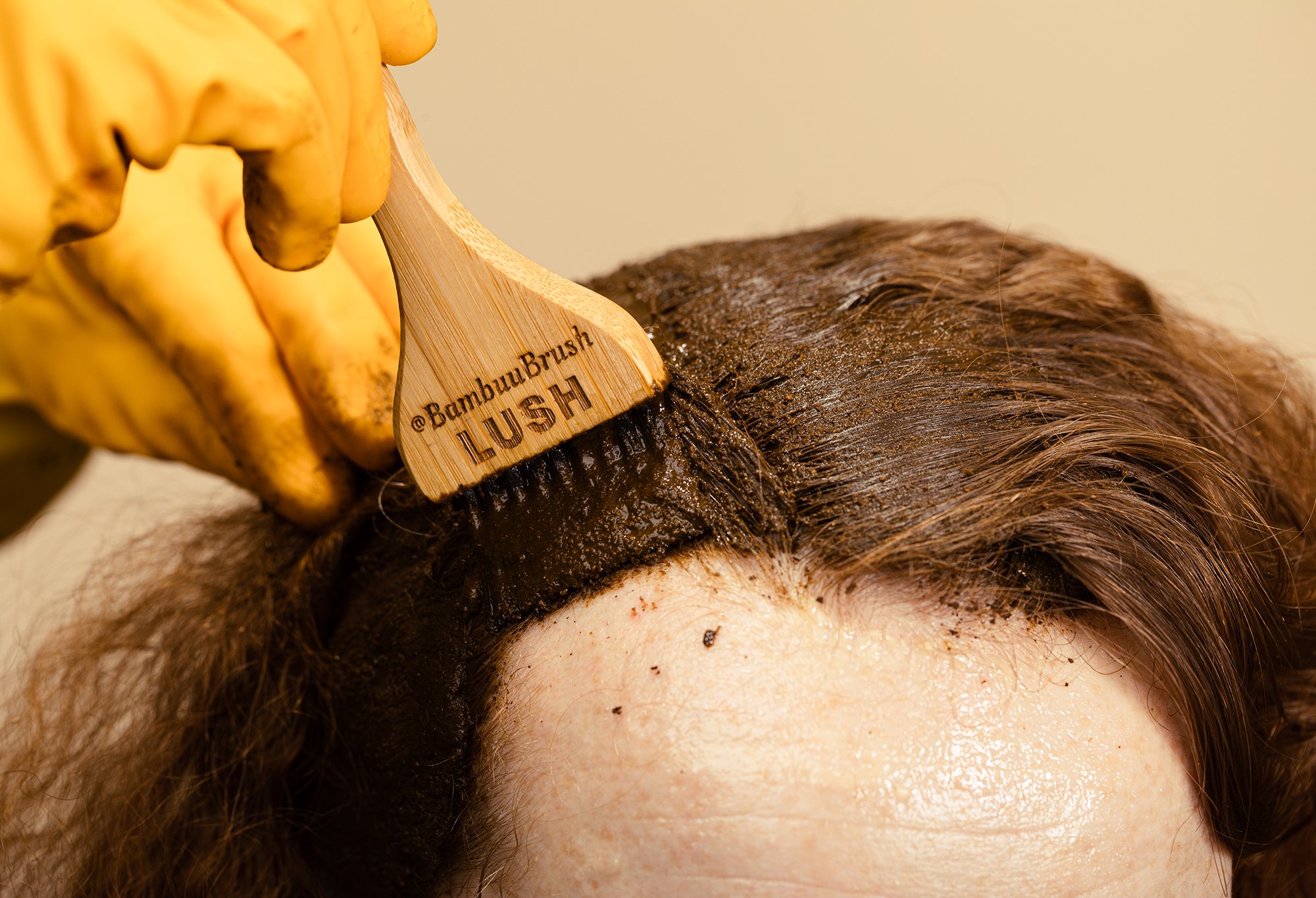
We've tried to answer as many of your questions here so you can henna with confidence and love your results.
What is henna?
Lawsonia inermis is a flowering plant that contains a pigment in its leaves known as lawsone which is capable of producing a rich red to orange dye. Believed to be indigenous to northern Africa and the Middle East, henna has been used to dye hair, nails and skin for thousands of years by communities in these regions.
How does henna work?
Henna contains a pigment called lawsone that has an affinity to the keratin in your hair. It adheres to the cuticle, adding a layer of sheer color without changing your natural hair color. This will very gradually fade over time. Our addition is cocoa butter which softens and helps it slip through the hair as you apply, and enables us to make a solid, self-preserving product.
What colors does Lush henna come in?
Lush henna comes in five shades. Here’s your quick guide:
Rouge Henna
This brick contains red henna to turn fair or red hair a vibrant shade of copper, or add spicy red tones to darker hair. The lighter the hair, the brighter the result! Dazzling on its own, this brick is also an essential base shade if you want to apply our Brun, Marron or Noir Henna to blonde, fair or twinkly gray hair.
Shop Rouge Henna
Marron Henna
Like the name suggests, this brick gives a sumptuous chestnut color with glints of red. Ideal for adding warm burgundy tones to brunette hair or depth to redheads. You’ll need an initial base coat of our Rouge Henna brick if your hair is blonde, fair or twinkly with grays.
Shop Marron Henna
Brun Henna
This brick is ideal for adding cool hazel tones and oodles of shine to light brown hair. If you’re looking to darken blonde, fair, or twinkly-with-gray hair, you’ll need to do a base coat of our Rouge Henna brick first.
Shop Brun Henna
Noir Henna
Our darkest brick is ideal for taking light brown hair a shade darker or adding cooler tones and gloss to warm brunette hair. If you’re looking to darken blonde, fair, or twinkly-with-gray hair, you’ll need an initial base coat of our Rouge Henna.
Shop Noir Henna
Vénitien Henna
Our latest addition to the range, this shine-enhancing brick gives warm strawberry blonde tones to naturally blonde and light brown hair. It can also be used to tint white hair golden red or to add warmth and shine to previously lightened hair if you’re ditching the bleach.
Shop Vénitien Henna
Why does Lush henna come in a brick rather than a powder?
Henna leaves are traditionally crushed, added to water and something a little acidic, like lemon juice, then used as a paste. It’s been an effective process for thousands of years, though the airborne dust is renowned for its ability, much like sand, to settle everywhere. It may also prove irritating to some people. Adding cocoa butter removes that inconvenience for the customer and creates an easier-to-use solid product, inspired by an ancient Asian form of currency: the tea brick.
“The cocoa butter replaces things like eggs or binders you might add into henna,” says Lush Founder, Mark Constantine. “It’s holding it together so you get this really cohesive dye instead of loads of stuff that’s dropping everywhere.”
It also adds gloss and condition to the hair, and makes the product easier to remove, as well as reducing the need for packaging.
What other effects will henna have on my hair?
“Some people use henna as a treatment for hair health rather than for color.” Mark continues, “Henna adds body, thickness, and shine. The extra body is particularly nice if you have fine hair. If you have thick hair, it won’t appear as sleek but the shine will be so much better.”
Application
Do I need to do a strand test on my hair?
Yes, it’s a really good idea to check you are happy with the color. You can easily do this by gradually adding a little freshly boiled water to a small amount of henna and stirring until you have a lovely creamy paste. Apply to a section of hair about half an inch wide (including twinkly gray hairs if you have any). Leave to develop for two hours, then shampoo, rinse and dry. Your shade will continue to develop for up to 48 hours after you apply it. We have samples available in our shops so you can give this a go at home.
How do I apply henna?
Can I apply henna to my own hair?
Of course. You should still focus on the roots first but you may want to adjust your application technique slightly to find a method that works for you. We recommend asking a friend to help though because you’ll usually get better results.
Can I use henna on my skin?
Our blends have not been created for this purpose. Pure, high quality, powdered body art henna is a neater option.
Can I use henna on my beard?
Yes, henna has been used for thousands of years to color beards so you are following in a fine tradition. Beard hairs are coarser than scalp hair fibers and so may require further applications. You’ll get the best result if you thoroughly cleanse your beard beforehand and you may wish to apply Ultrabland Facial Cleanser around the beard line.
Can I use henna on my eyebrows or eyelashes?
Please do not use henna anywhere near the area of the eye. Lush henna bricks have been designed for use on thicker scalp hairs and so we do not recommend using them on the very fine eyebrow and eyelash hairs.
Can I combine henna bricks to tailor my color?
Yes, absolutely.
Can I add other materials to my henna?
You can, but we’ve already done that for you to create what we believe to be a shine-enhancing, hair-nourishing final product.
Can I freeze henna?
Henna is best used fresh so we don’t advise freezing the bricks or paste.
Color and coverage
How does henna compare to synthetic dye?
Henna works most similarly to temporary hair dye because it coats rather than penetrates the hair fiber and does not have the power to lighten your hair, but the results are far longer-lasting. The lawsone within the henna leaf adheres to the outer layer of your hair (the cuticle) adding body and color that still allows your natural pigment to shine through. Unlike permanent synthetic dyes, henna will not dye your hair a uniform color, the subtle lowlights and highlights in your hair will shine through in a naturally beautiful way.
How long does henna last?
Over time, you can expect natural fading of the henna but if you have blonde or white hair, the majority of the pigment will stay visible. With darker shades like Noir and Brun, you may lose some of their cooler tones with regular shampooing.
Will henna lighten my hair?
Henna does not have the power to lighten your hair, although it picks up on the natural highlights and lowlights beautifully, rather than dyeing the hair a uniform color.
How can I go darker if my hair is naturally light?
If you are planning to dye light hair darker, we recommend applying a base of Rouge first. Once you have applied Rouge, you can follow up with your preferred color on dry hair as soon as you like, whether that’s Brun, Noir or Marron. Additional applications of Marron, Brun or Noir may be needed to get a darker shade, but your color will continue to oxidize over a couple of days and will subtly darken by itself.
Will henna cover my gray or white hairs?
Gray is the color we perceive when we look at hair fibers that have lost their melanin and turned white amongst fibers that still retain their natural dark color. If your hair is naturally blonde, these white hairs instead give the impression that your overall hair color is lightening. “Gray”, or white hairs tend to be coarser than pigmented hairs and are more resistant to dye. Henna does not have the power to conceal grays, unlike permanent synthetic hair which can lift the cuticle scales to deposit color inside the cortex of pigmented and unpigmented hairs, giving a uniform result.
Henna can, however, have a stunning effect on graying hair. It tints them in a dazzling, twinkly way that looks healthy and natural. On a smaller number of gray hairs, using henna creates a highlights-esque effect. It can also help them to blend into the rest of your hair a little more if that is desirable. To achieve deeper coverage when using Marron, Brun or Noir on hair that has more than a sprinkling of gray, we recommend using Rouge as a base and then following with your chosen color. This helps these darker bricks adhere more effectively.
Reapply your henna as often as you like to keep the coverage fresh and your lighter hairs extra twinkly. Topping up with a Rouge base followed by your chosen brick regularly, will provide the best coverage. If your hair is mostly white or gray, henna will have a very vibrant effect!
Henna and Textured hair
Is henna suitable for curly, coily and textured hair?
Yes, henna can have a lovely protective effect on curl patterns from 3A to 4C, especially if they are high porosity. You may notice that the combability of your hair is not improved when using henna (that’s because you are slightly increasing the density of the hair fiber) but the shine is fantastic.
Lush HairLab consultant Sarah Sango says, “Henna is a lovely way to color your hair if you don’t want to damage it with a permanent dye. It may also give your curl pattern more definition. Based on feedback I have had from clients, the weight of the product can slightly loosen the tightness of the curls, which may or may not be desirable. Using henna on high porosity hair can also help fill open cuticles.”
You may find it a little trickier to apply henna evenly to curly or coily hair, so allow yourself plenty of time and product, and rope in a friend if possible. Mark Constantine adds: “If you have very curly or coily hair, henna can be a big job because it becomes harder to wash all of the particles out. The cocoa butter helps with that. A conditioner also creates more slip on the hair when rinsing away.”
Can I use henna if I am transitioning from relaxed to natural hair?
Yes, and what a lovely treat to give your hair! Just bear in mind that you are working with different textures and henna can increase the diameter of the hair fiber, which may increase combing work. Using henna powder on transitioning hair can sometimes leave it feeling stiff but the cocoa butter in Lush henna helps with this, making the hair softer and more pliable. Relaxed ends are also likely to be very porous and accept the color more quickly than natural roots. If your hair is dark, this is less likely to show but bleached or blonde hair may have a very bright result at the ends. This can actually give a rather lovely balayage effect. Multiple applications will be key if you wish to build coverage.
Can I apply henna to braids or a similar protective style?
It’s advisable to only apply henna when your hair is loose to ensure that you have a thorough and even result (and are able to remove the henna successfully).
Can I use henna on my locs?
Henna has a lovely effect on locs, adding sheen, moisture and fullness. However, you will need to pay more time and attention than usual when washing the henna away to ensure the tiny particles are fully removed. We advise rinsing with a conditioner to aid slip in the hair then following up with Avocado Co-Wash. Strand-testing is the best way to judge the scale of your job.
Can I use henna on my extensions?
Henna can be a great option for human hair extensions (not synthetic) to add depth or change color without inducing damage. Just make sure to do a strand test on both the extensions and your own hair to ensure you have a color match you are happy with.
Henna and synthetic color or chemical treatments
Can I use henna on bleached hair?
Yes, henna can give beautiful color and care to bleached hair, though it is not suitable if you lighten your hair regularly. You could choose to have highlights then henna over the top for a beautifully vibrant result.
There are some points to bear in mind, though. Extensively bleached hair is porous and especially susceptible to very bright results so be extra vigilant with the strand test and always apply a base of Rouge before using Marron, Brun or Noir. You may need to use further applications to reach your desired color. Vénitien may be used directly on bleached hair without the base of Rouge.
Henna is not suitable to use before a bleaching process, however, as the alkaline conditions open the cuticle and push the lawsone deeper into the hair fiber. (For this reason, you should also not try to bleach henna out of your hair!) Wait for visual fading of the color and do a strand test if you want to bleach hennaed hair.
Am I able to use henna if my hair has been colored with synthetic hair dye?
Generally speaking, henna is not the best option for you if you wish to change your hair color regularly, but it can be used alongside synthetic dyes in some circumstances.
The good news is that you can usually apply henna straight over the top of synthetic color without any issues, though you should make sure you complete a strand test to check the result.
Coloring over the top of henna with a permanent or demi-permanent product is a trickier task. This is because the dye will find it harder to penetrate the cuticle and the bleaching action of the product will be less effective or could push the henna deeper into the hair fiber. If you wish to use a permanent or demi-permanent dye over the top of hennaed hair, wait at least one month. Or, better still, until your henna has recognizably faded, and then rely on a strand test to predict the results. You may need to wait longer, depending on how well the henna has taken to your hair and how dramatic a change you are making. It is also important to not use shades that are lighter than your hennaed hair — instead opt for shades at the same depth or darker.
If you are using a semi-permanent or temporary color, which deposits color on the cuticle and has no lightening power, you can usually apply this after using henna without any issues. Be aware that these products do not induce dramatic color changes on the hair however, (except in the case of fair, white or gray hair) so you may not get your desired effect.
Can I use Lush henna on relaxed or permed hair?
Despite the rumors, yes, you can — with a bit of forethought. Henna has a complicated reputation when it comes to perms, as the metallic compounds historically added to henna played havoc with the permed coiffures of many women in the 1930s. You won’t find any of these in Lush henna. Both relaxer and perming chemicals need to penetrate the cuticle to induce structural changes in the hair however, so using henna beforehand (which adds a layer to the cuticle) will reduce the effectiveness of your treatment.
Using henna after your treatment is a lovely way to bring condition and shine to recently treated hair. Mark Constantine advises waiting at least three days after relaxing or perming the hair to allow the structural changes to solidify, while Sarah Sango suggests allowing a couple of weeks for textured hair that is particularly fragile after being relaxed.
If you both henna and perm or relax your hair regularly, you may not quite achieve the desired structural changes, but your hair will look in much better condition. It’s also natural for a little of the henna color to come away from the fiber during a perm or relaxer so don’t be alarmed.
Allergies, health and henna
Can I use henna if I have a wound on my scalp?
Do not use henna on cut or abraded scalps.
Do I need to do a skin patch test before using henna?
Pure henna has very low allergenic potential and most reactions come from additives to the product such as para-phenylenediamine. However, if you are concerned, you can easily do a patch test at home. Simply whip up a small amount of Lush henna paste with hot water and apply it to your inner elbow (this is where your skin is thinner.) Cover with a plaster or wrap, rinse clean after 48 hours, and keep an eye out for any redness or irritation in the skin over the next 96 hours (aside from the natural staining of the skin). If you notice any irritation, do not proceed with a head application.
Is henna suitable for me to use if I have an allergy to synthetic hair dye?
Yes! Lush henna does not contain any of the materials that induce allergy in hair dye-allergic individuals and is regularly tested for contaminants.
Are there any medical reasons I should not use henna?
Very few, however, henna is not suitable for individuals who have an allergy to authentic henna or have glucose-6-phosphate dehydrogenase deficiency (G6PD).
Is henna safe to use during pregnancy?
This is a very personal decision. Henna’s incredibly long use gives it good safety credentials, and a lot of women choose to use it during pregnancy. Many ancient customs that involve direct skin painting of a mother-to-be with henna during late pregnancy are still popular today. However, if you have any concerns about your pregnancy, avoiding all hair colorants while trying to conceive and at least during the first trimester appears to be the safest option.
Ready to henna?
Still have more questions?
If we’ve missed anything, please don’t hesitate to contact us for further clarification.
Homepage - Henna Hair Dye FAQs